
My System
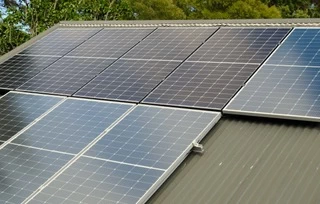
This is an installation I've designed myself, based around our existing 250Ah battery bank of Pb-C lead-acid batteries; eight 6v batteries in series for a 48v system. There are 14 solar panels in two separate arrays giving a total max power rating of 5.2Kw, making a good working balance with the 250Ah battery bank. The Studer inverter/charger is one typically used in an off-grid situation with an auto-switched backup generator feeding into the AC-in connections, but we are connected to the grid and the inverter input is switched on and off with a switch on the main c/breaker board. This changes the operation mode between inverter mode (no grid input) and mains/charger mode (grid connected). In normal operation, certainly consistantly during the summer and/or mainly sunny days, the Studer is running in inverter made, with no grid connection, and its DC/AC inverter providing the energy to its loads. The batteries are being charged each day solely by the sunlight. So for much of the year the system runs essentially as an off-grid one. The mode is manually changed to mains/charger for periods where the solar provision is insufficient or for occasionally fully charging the batteries from the grid.
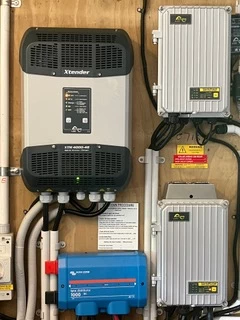
We have two c/breaker boards and they are both partitioned into two separated sections; one section fed by the inverter AC output and the other from the grid. The inverter feeds the critical loads, those we choose to have powered at all times. These are the fridge/freezer, lights, some household power points (wifi modem, tv etc), heat-pumps, hotwater heat-pump and water tank pumps. By using a crossover switch in one of the c/breaker boards we can power these loads from the grid when neccessary. The rest of the loads, woodworking machinery, oven, clothes drier, dishwasher, washing machine, kitchen appliances and a few others are only ever fed by the grid. Given that we're committed to utility line charges anyway it seems logical to run these appliances without loading up the solar system, which means we have kept the system smaller and less expensive.
To a small extent this is a hands-on operation that requires manual adjustments from time to time, whereas a hybid inverter does all the adjustments automatically. In either case you're always going to need a certain energy contribution from the grid, but with this system it's one or the other at any particular time and the two sources fed into the switchboard are not fed in parallel, as they are with a hybrid inverter. During the winter and/or darker days there is a need to monitor energy flows and occasionally manually switch between modes or put the inverter's share of the load onto the grid for periods when the batteries are not being charged. For long periods over summer months the system can run by itself without adjustments.
We have found this a much more satisfing experience than we had with the hybrids. We have a Studer remote control inside the house from which we can monitor everything and reset any operational parameters should something need changing. The Studer's operating mode is controlled from a circuit breaker inside the house and its 50a mains charger can be switched on manually when needed and its progress monitored on the remote control.
The beauty of this Studer system is its versatility, simplicity and robustness. The XTM4000 inverter basically consists of a DC-AC inverter, a powerful AC battery charger and a transfer relay and the operational control electronics. It has no internal MPPT solar energy input ports; the solar charging is done with two externally mounted solar charge/controllers. All of these three units are low frequency pieces with a transformer employed rather than high-frequency transistor switching of most other systems. It is designed for off-grid operation where it's running 24/7/365.
The battery bank is attached to a Studer battery status processor comprising of the management module, a temperature sensor and a battery shunt. I know exactly what the state of the batteries is at all times and can make manual adjustments to the charging operation at will. This processor is what has made it possible to use lead-acid batteries, which opens up the possibility of much cheaper batteries than lithium packs. The Studer is also fully compatible with low-voltage lithiums.
There is also a Studer online portal which is accessed by the remote control or online from a computer/cellphone. The operation is also monitored by the solar provider.
I've rewired the house circuit/breaker boards so that we can switch between inverter modes from inside the house. I've also added a changeover switch so I can select either the inverter or grid supply to feed those loads normally supplied by the inverter. If there's not much solar and the batteries are only half charged or so, but there's no need for a mains charge, we can switch the inverter load off. Then the batteries will stop discharging and the grid can run the house until it's sunny again.
This system is scalable up or down and can be designed with other manufacturers' equipment. It can accommodate as much of the household (or farm) load as necessary. In this way, it is equally suitable as an emergency energy supply for a small load or as a source for the whole house, or anything in between.
There are a few less expensive ways of achieving the same basic installation, still allowing the versatility of lead-acid or lithium batteries. Using an inverter/charger in a grid-connected scenario requires that the A/C feed is not fed into the house in parallel with the grid, as it is with a hybrid. The A/C supply is actually isolated from the grid altogether by means of a power switching mechanism or crossover switch, and anti-islanding is achieved through the Studer architecture's toroidal coil isolating the common neutral line from possible phase leakage currents. There are only a few other inverter/charger options that will satisfy safety inspection in this way.

