
Solar Panels
Typically a single panel will produce around 400 watts of DC power in optimal sunlight conditions. There are variables that reduce this rated output; which direction they're facing, the sun's position in the sky relative to your array, the slant of the roof having a bearing on the angle the sun's rays strike the panel surface, shadows falling across the array. The windblown flowers of certain adjacent trees may gum up the panel surface. All in all, there can be a considerable variation in the available solar energy over the year.
A typical household installation might have the total number of panels arranged in one or two 'strings' or rows of panels. The strings need not be the same, nor oriented in the same direction or azimuth angle. A single string may be configured as a group of panels all connected in series or in a series/parallel configuration.
The maximum voltage and current of each array must conform with the MPPT input requirements of the inverter or solar charge/controllers. Panels are rated for their max voltage under open-circuit conditions (Voc) and their max current under short circuit conditions (Isc). These are the specifications to note when matching panels with MPPT requirements. These are NOT the specs indicated with the diagrams below, which simply show how a typical array produces its working energy.
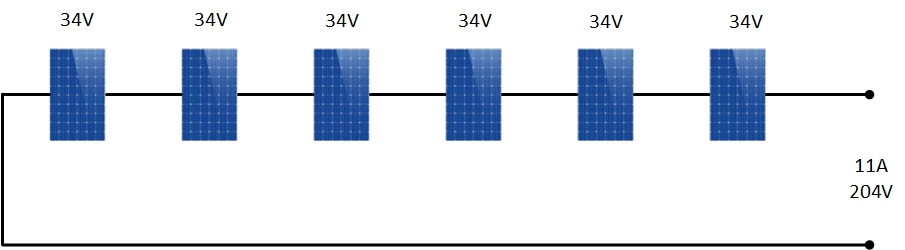
Each panel in the two diagrams below produces a max power of 370w from a working voltage of 34v and a max current of 11a. The working voltage (Vmp) remains more or less constant throughout the day after the panels are switched on by the sun's energy, but the current produced fluctuates considerably in accordance with the amount of sunlight received. So it's the variation in current (Imp) which alters the amount of power produced throughout the day. The max power produced in both configurations is the same at 2.2Kw but their combined voltages and currents are different. This is why you would need to be using different inverter or controller/charger MPPT inputs for each of them.
The series arrangement below supplies 204v (the sum of 6 x 34v). The current can be anything from zero to a max of 11a. Grid-tie inverters and hybrids run more efficiently with a high voltage input, suiting a series string array. A typical Vmp voltage input range for these is around 160-500v or so.
Arranged as a series/parallel array they will have half the voltage and double the current of the series configuration. Shown below there are two groups of three panels in series, paralleled together. So the voltage is now the sum of three panels which is 102v. The current on the other hand is twice 11a which is 22a. Consequently, a charger/controller with a higher current rating and lower voltage rating is needed.
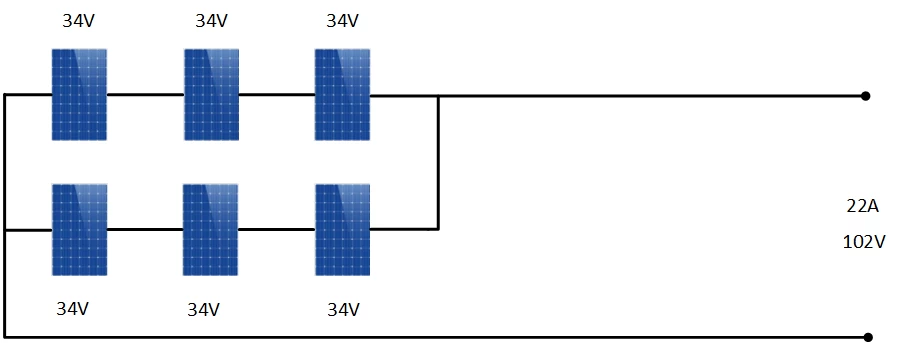
Each half of this array may be oriented differently to allow for shading issues or roof section area limitations etc. Consequently this arrangement is a better prospect than a series configuration where these issues come into play. With shade falling over some of the panels on one half of the string the other half will still be productive, which is not the case with a series string where shade over any part of the array will compromise the whole string.
An array facing east or west is going to produce less midday energy than a north-facing array but be more productive mid-morning or mid-afternoon. They will be more affected by the sun's northerly aspect during winter months. Overall, try to align you array(s) to maximise the winter solar capture as it's usual to have plenty to spare during the longer days. It's important to spend some time thinking about your solar configuration before ordering any other equipment.

